
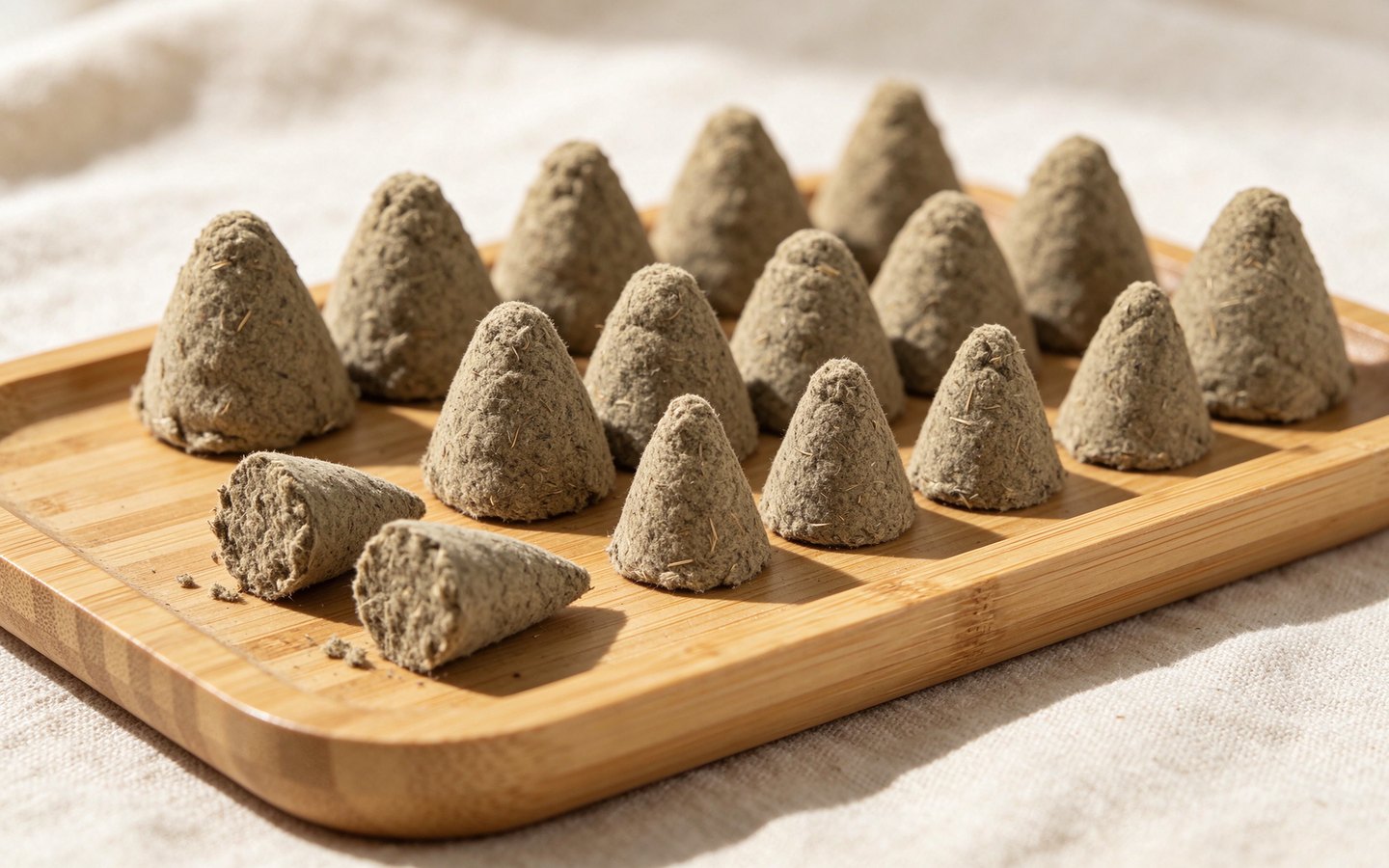
Moxa cones, pre-formed in three sizes
Consistent cone size means a consistent session: same fill weight, same burn time, same ash behaviour, box after box. Built for clinics, studios and home-use kits.
Specification
Ranges are indicative. The signed sample and spec sheet define the order — if a parameter is not measurable, we do not put a number on it.
Why cones are bought pre-formed
A cone is a fixed dose of moxa. That is the whole point: the practitioner does not pinch wool to size in front of a client, and the studio does not depend on one person's hand. Pre-formed cones give a repeatable burn, a predictable ash and a clean unit cost.
Three things decide whether a cone works in your setting:
- Size against technique — small cones suit indirect work where the cone sits on a slice of ginger, salt or garlic; larger cones carry more heat and a longer burn.
- Density — a loose cone collapses and burns unevenly. Ours are pressed to a set density, verified on the sample you approve.
- Base — a flat base stays put on a medium; a self-adhesive ring helps in clinic formats where the cone must not shift.
If your line also carries sticks, the two pages are deliberately separate: moxa sticks → covers the retail format and the paper-print options.
MOQ, pricing structure, lead time
Quantities
- Standard MOQ 5,000 pcs per size
- Trial from 1,000 pcs
- Mixed sizes: 2,000 pcs per size, two sizes minimum
- Retail blister runs quoted separately
How price is built
- Size and fill weight — the main variables
- Ratio: 5:1 to 20:1
- Plain base or adhesive ring
- Box and blister configuration
- Incoterm and consolidation
Quoted per order; the per-piece price moves with wool ratio and packing.
Lead time
- Samples: 7–10 days
- Production: 25–30 days after spec approval
- Blister or printed box adds 5–7 days
- Consolidation with rolls or boxes on request
Documents that ship with the order
Batch record
Lot, ratio, fill weight per cone, pressing date, packing date.
Third-party test report
Residues, heavy metals, microbiology — per lot.
Retention sample
A sealed sample of your lot stays with us for re-testing.
See what a batch record contains → · How Qichun origin is verified →
Where this product goes
The compliance question changes by market and by the claim on the pack. These are the routes buyers actually use:
- United States and EU: clinics and home-kit assemblers; kits need their own labelling
- Singapore and Malaysia: studio supply and repackaging
- Indonesia and Philippines: registration sits with the finished product brand
- Japan and Korea: tight fill-weight tolerance and ash behaviour
Questions buyers ask before the first order
Cone or stick — what should a clinic buy?
Cones for fixed-dose indirect work and kit assembly, sticks for handheld and retail formats. Many clinics carry both; the split is usually decided by the technique used in the room, not by price.
Can the cones sit on ginger, salt or garlic?
The cone is designed with a flat, stable base for traditional indirect placement. Which medium your practitioners use is a clinical decision on your side; our job is a consistent cone that does not collapse.
How many sizes do you make?
Three: small, medium and large. Fill weight is declared on the spec sheet rather than guessed from a photo, and it is verified on your sample.
Is there a trial quantity?
Yes, 1,000 pcs on one size. Mixed-size trials start at 2,000 pcs per size with two sizes.
Can I have my own box and leaflet?
Yes, from 5,000 pcs. We review the artwork for claim language before print, and the leaflet has to match the claims on the box.
What is the burn time?
It follows size, density and ratio, so we state it per SKU on the spec sheet after your sample is approved — not as a single number for the whole range.
Send the specification you are buying against.
Tell us the format, size and pack you need. We will come back with a quotation, the sample lead time and the documents your market asks for — before you commit a season to it.
Get a quotation See all product lines